
Fermented vs. Vinegar-Pickled: What's Actually in the Jar
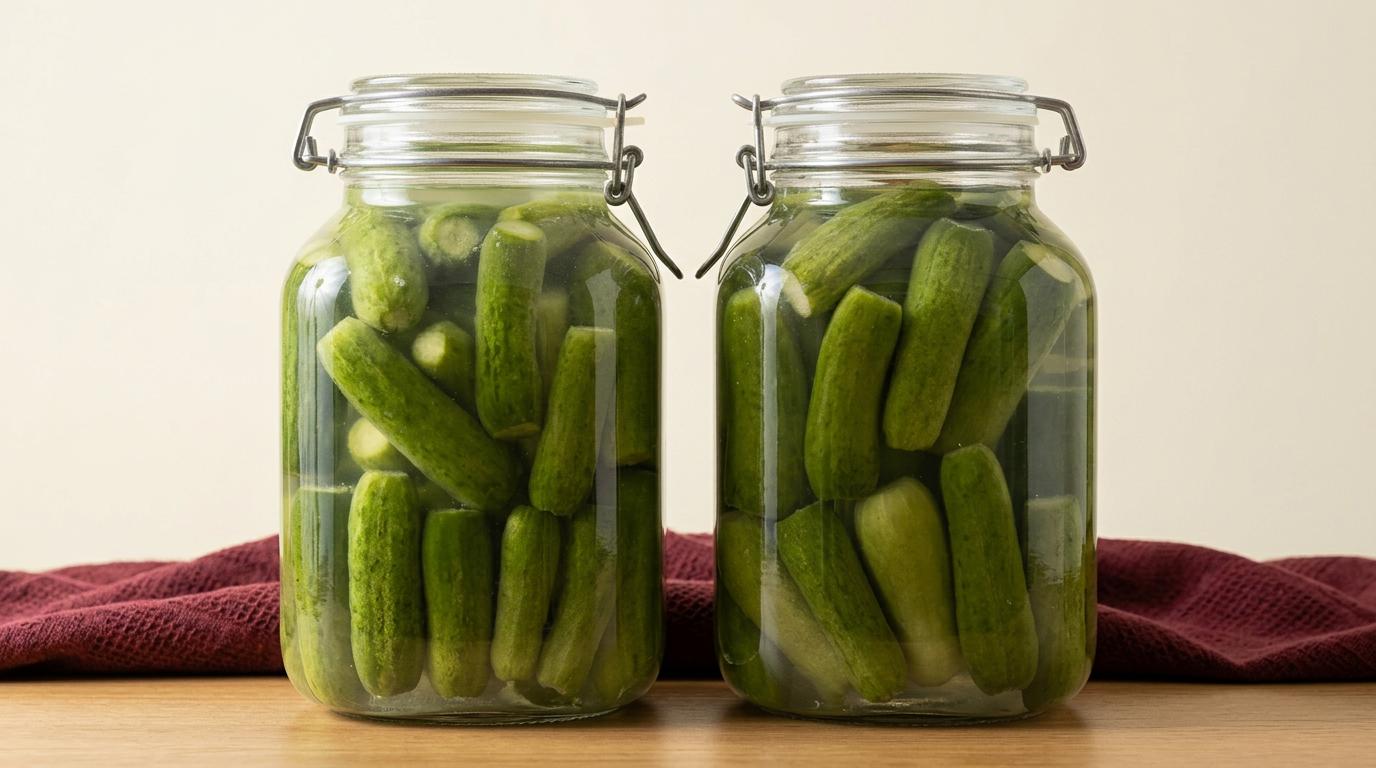
Not every pickle is fermented
Walk down any supermarket aisle in the UAE and you'll find shelves of pickles. Most of them are sour, crunchy and salty, so it's easy to assume they're all made the same way. They're not.
There are two very different ways to turn fresh vegetables into something sour: vinegar pickling and natural fermentation. One adds sourness from the outside. The other lets it grow from within. The difference shows up in the flavour, the texture, the brine and what's actually living in the jar.
Here's how each one works, and how to tell which one you're buying.
How vinegar pickling works
Vinegar pickling is fast and predictable. Vegetables go into a brine of vinegar, water, salt and sometimes sugar and spices. The vinegar's acetic acid does the work: it makes the jar too acidic for spoilage bacteria and gives the vegetables their tang.
Most commercial pickles are made this way, and many are then heat-processed so they can sit on a shelf for months. Some "quick pickles" are ready in a few hours.
What you get:
- Flavour: a sharp, straightforward tang that tastes mostly of vinegar
- Brine: usually clear
- Texture: firm, though heat processing can soften it
- What's in the jar: no live cultures, especially once pasteurised
Vinegar pickles are perfectly good food. They're just a different thing.
How natural fermentation works
Natural fermentation (often called lacto-fermentation) needs only vegetables, salt and time. There's no vinegar.
Vegetables naturally carry lactic acid bacteria on their surface. Submerged in salty brine, or packed in their own salted juices as with sauerkraut, those bacteria get to work. They feed on the vegetables' natural sugars and produce lactic acid. Over days or weeks, the jar slowly turns sour on its own, and that acidity is what preserves it.
What you get:
- Flavour: sour, but rounder and more layered, with a savoury depth that keeps developing
- Brine: often cloudy, sometimes with gentle bubbles, both signs of active fermentation
- Texture: crisp, with a satisfying bite
- What's in the jar: live cultures, as long as the product isn't pasteurised afterwards
It's slower and less predictable than vinegar pickling. Temperature, salt level and the vegetables themselves all change how a batch turns out, which is exactly why it rewards patience.
Side by side
| Vinegar pickling | Natural fermentation | |
|---|---|---|
| Where the sourness comes from | Added vinegar (acetic acid) | Made in the jar by bacteria (lactic acid) |
| Main ingredients | Vegetables, vinegar, water, salt | Vegetables, salt, water |
| Time | Hours to a few days | Days to weeks |
| Flavour | Sharp, vinegary | Sour, rounded, layered |
| Brine | Usually clear | Often cloudy, may bubble |
| Live cultures | No | Yes, if not pasteurised |
| Storage | Often shelf-stable | Usually kept in the fridge |
How to tell them apart when you shop
- Read the ingredients. If vinegar is listed, it's a vinegar pickle. A naturally fermented pickle lists vegetables, salt, water and spices.
- Check where it's stored. Fermented products with live cultures usually sit in the chiller, not on the dry shelf.
- Look at the brine. Cloudiness is normal and expected in a fermented jar. It isn't a fault.
- Look for the words. "Naturally fermented" or "lacto-fermented" on the label is a good sign. "Pickled" on its own tells you very little.
How we make ours
Everything at Zad w Mouneh is naturally fermented. No vinegar, no shortcuts. Just vegetables, salt and time, made by hand in limited batches.
That goes for our pickles, The Original, The Dill and The Trio; our krauts, Classic Kraut and Crimson Kraut; The Harvest, a mix of green peppers and vegetables; and our pepper paste The Red & Bloom. Each batch is left to ferment at its own pace, nothing rushed, until the flavour is where it should be.
So when you open a jar and see a slightly cloudy brine, that's not a flaw. That's the fermentation doing its job.
Because the cultures are still alive, every jar needs to live in the fridge. Keeping it cold slows the fermentation down and keeps the flavour and crunch just right.
Frequently asked questions
Are all pickles fermented?
No. Most supermarket pickles are made with vinegar and aren't fermented. Naturally fermented pickles get their sourness from lactic acid made in the jar.
Is sauerkraut fermented?
Traditional sauerkraut is cabbage fermented in salt, with no vinegar. Some shop-bought versions are pasteurised or made with vinegar, so check the label.
Why is the brine in my fermented pickles cloudy?
Cloudy brine is a normal result of lactic acid bacteria at work. It's expected in naturally fermented vegetables.
Do fermented pickles contain probiotics?
Unpasteurised fermented vegetables contain live cultures. Research on fermented foods and gut health is growing, but the amount and type of bacteria varies from jar to jar.
Do fermented pickles need to be refrigerated?
Keeping them cold slows fermentation down and keeps the flavour and crunch where they should be. All Zad w Mouneh jars should be kept refrigerated, before and after opening.
More frequently asked questions
Taste naturally fermented mouneh
Shop the jars